




10 Free Google AI Courses to Learn AI Skills in 2026
Ten free Google AI courses ordered so the foundations come first, each with a note on what it assumes you already know before starting.
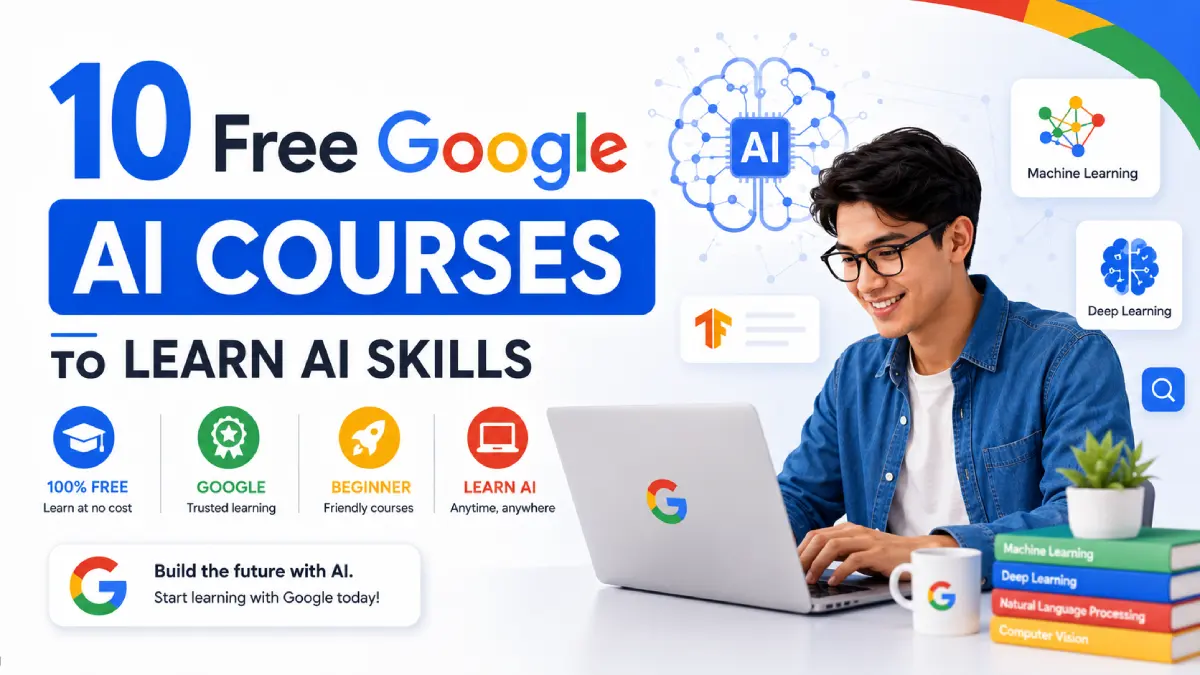
Google's free AI courses are uneven. Some are polished introductions that assume nothing; others are twenty-minute technical explainers that will lose you without prior background.
The ten below are ordered so the foundations come first, each with a note on what it assumes you already know.
If the answer is yes, these Free Google AI Courses can help you build valuable AI skills in 2026. Google has made several AI learning programs available at no cost, giving students, professionals, developers, marketers, educators, and business owners an opportunity to learn directly from Google’s AI ecosystem.
Whether you're completely new to AI or looking to deepen your understanding of modern machine learning concepts, these courses provide structured learning paths covering everything from image generation and transformer models to responsible AI and generative AI applications.
In this guide, we'll explore the 10 best Free Google AI Courses, what you'll learn in each course, who should take them, and how they can help advance your AI knowledge.
Quick Overview of the 10 Free Google AI Courses
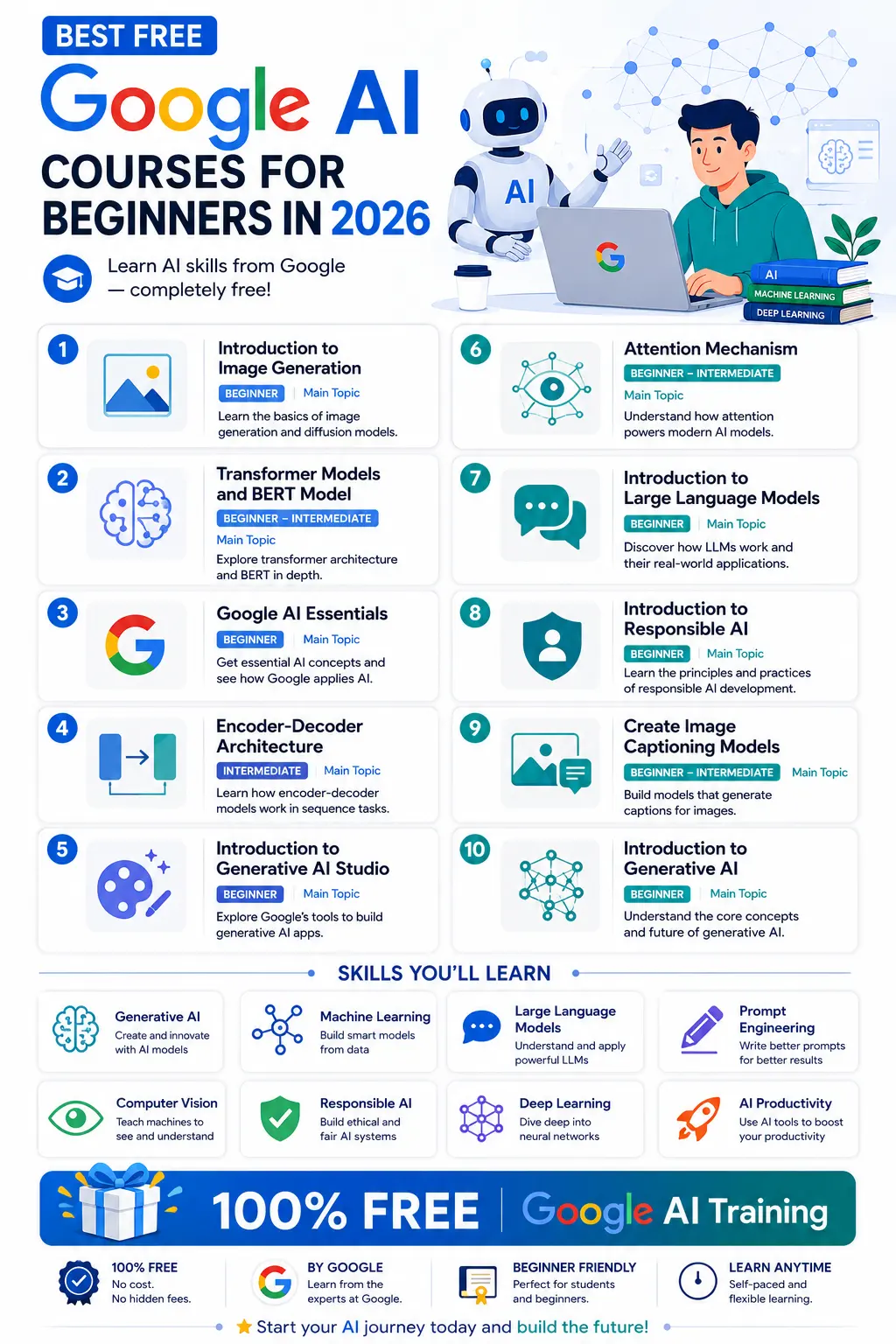
| Course | Main Topic | Skill Level | Course Link |
|---|---|---|---|
| Introduction to Image Generation | Diffusion Models | Beginner | https://www.skills.google/course_templates/541 |
| Transformer Models and BERT Model | NLP & Transformers | Intermediate | https://www.skills.google/course_templates/538 |
| Google AI Essentials | AI Fundamentals | Beginner | https://grow.google/ai-essentials/ |
| Encoder-Decoder Architecture | Sequence Learning | Intermediate | https://www.skills.google/course_templates/543 |
| Introduction to Generative AI Studio | Vertex AI | Beginner | https://www.skills.google/course_templates/552 |
| Attention Mechanism | Deep Learning | Intermediate | https://www.skills.google/course_templates/537 |
| Introduction to Large Language Models | Large Language Models (LLMs) | Beginner | https://www.skills.google/course_templates/539 |
| Introduction to Responsible AI | Ethical AI | Beginner | https://www.skills.google/course_templates/554 |
| Create Image Captioning Models | Computer Vision | Intermediate | https://www.skills.google/course_templates/542 |
| Introduction to Generative AI | Generative AI Fundamentals | Beginner | https://www.skills.google/course_templates/536 |
1. Introduction to Image Generation
Image generation has become one of the most exciting areas of modern AI. This course introduces diffusion models, a powerful machine learning approach used to create realistic images from text prompts.
What You'll Learn
- Fundamentals of image generation
- How diffusion models work
- AI-generated image workflows
- Applications of image creation systems
- Modern trends in visual AI
Who Should Take It
This course is ideal for:
- Beginners interested in AI creativity
- Designers exploring AI tools
- Developers learning computer vision
- Content creators using AI-generated images
As one of the most practical google artificial intelligence courses, it helps learners understand technologies behind modern image-generation platforms.
2. Transformer Models and BERT Model
Transformers changed the AI industry forever. Most modern language models rely on transformer architecture.
This course provides a comprehensive introduction to transformer models and Google's BERT model.
What You'll Learn
- Transformer architecture basics
- Natural language processing concepts
- BERT model fundamentals
- Language understanding techniques
- Modern NLP applications
Key Benefits
Understanding transformers is critical for anyone who wants to learn ai with google because many advanced AI systems are built upon these architectures.
3. Google AI Essentials
Google AI Essentials is one of the most beginner-friendly programs available.
If you're completely new to AI, this course provides a practical introduction to generative AI and everyday AI tools.
What You'll Learn
- AI fundamentals
- Generative AI basics
- AI-assisted productivity
- AI-powered decision making
- Content creation with AI
- Daily AI workflows
Why It Stands Out
Unlike highly technical courses, Google AI Essentials focuses on practical usage rather than complex mathematics.
It's often considered the best starting point among google ai training courses.
Ideal For
- Students
- Professionals
- Freelancers
- Entrepreneurs
- Educators
- Office workers
4. Encoder-Decoder Architecture
Encoder-decoder architecture is a foundational concept in machine learning, especially for sequence-to-sequence tasks.
This course explains how information is encoded, processed, and decoded to generate outputs.
What You'll Learn
- Sequence-to-sequence models
- Machine translation systems
- Neural network architectures
- Data representation techniques
- AI language processing workflows
Career Relevance
Many AI-powered translation and summarization systems rely on encoder-decoder models, making this course valuable for aspiring AI practitioners.
5. Introduction to Generative AI Studio
Generative AI Studio is part of Google's Vertex AI platform.
This course introduces learners to the tools used for prototyping and customizing generative AI models.
What You'll Learn
- Vertex AI fundamentals
- Prompt engineering basics
- Model customization
- AI prototyping workflows
- Enterprise AI applications
Why It Matters
Generative AI is increasingly being adopted across industries. Understanding how to work with AI platforms can improve productivity and technical capabilities.
This is one of the most practical Free Google AI Courses for professionals exploring business applications of AI.
6. Attention Mechanism
Attention mechanisms are among the most important breakthroughs in deep learning.
They enable neural networks to focus on relevant parts of input data, significantly improving model performance.
What You'll Learn
- Attention fundamentals
- Neural network optimization
- Context understanding
- Sequence modeling
- Deep learning applications
Who Should Take It
This course is recommended for:
- AI enthusiasts
- Data science students
- Machine learning engineers
- NLP learners
Although slightly more technical, it provides valuable insights into how modern AI systems process information.
7. Introduction to Large Language Models
Large Language Models (LLMs) are at the center of today's AI revolution.
This course introduces learners to LLM concepts, applications, and optimization techniques.
What You'll Learn
- What LLMs are
- How language models work
- Common use cases
- AI assistants and chatbots
- Model improvement strategies
Why This Course Is Important
Many businesses are integrating LLM-powered solutions into customer support, content creation, marketing, and software development.
Anyone pursuing AI Training should understand how these systems function.
Skills Gained
- Prompting techniques
- Language model fundamentals
- AI application knowledge
- Conversational AI understanding
8. Introduction to Responsible AI
AI development must be ethical, transparent, and responsible.
Google's Responsible AI course explains why ethical AI practices matter.
What You'll Learn
- Responsible AI principles
- Bias reduction strategies
- Fairness in AI systems
- Ethical decision-making
- Trustworthy AI development
Why Responsible AI Matters
Organizations increasingly prioritize ethical AI implementation. Understanding responsible AI can help professionals build more trustworthy AI solutions.
Among all google artificial intelligence courses, this course focuses on the human and societal impact of AI technologies.
9. Create Image Captioning Models
This course combines computer vision and natural language processing.
Learners build image captioning models capable of generating descriptions for visual content.
What You'll Learn
- Image recognition basics
- Deep learning workflows
- Caption generation
- Computer vision applications
- AI model development
Real-World Applications
Image captioning is used in:
- Accessibility tools
- Search engines
- Social media platforms
- Content management systems
- Visual content indexing
This course offers practical exposure to AI model building.
10. Introduction to Generative AI
Generative AI continues to reshape content creation, productivity, software development, and business operations.
This introductory course explains the fundamentals of generative AI and how it differs from traditional machine learning approaches.
What You'll Learn
- Generative AI concepts
- Machine learning differences
- Content generation systems
- Business applications
- Future AI trends
Perfect for Beginners
If you're starting your AI journey, this course provides a strong foundation before moving to more advanced topics.
It remains one of the most recommended free google ai courses for newcomers.
Frequently Asked Questions (FAQs)
Are these Free Google AI Courses really free?
Yes. Google has made these AI learning resources available at no cost, allowing learners to study AI concepts without paying course fees.
Which course should beginners start with?
Google AI Essentials and Introduction to Generative AI are excellent starting points for complete beginners.
Do I need coding experience?
Not necessarily. Several courses are designed for non-technical learners, while some intermediate courses benefit from basic programming knowledge.
How long does it take to complete these courses?
Completion times vary by course. Most introductory courses can be completed in a few hours, while technical courses may require additional study time.
Picking a Starting Point
Working through all ten in order is the slowest route. Most people need two: one foundation course and one aimed at whatever they are actually trying to build.
If you cannot decide, start with the shortest. Finishing something short beats abandoning something thorough.
Pair these with a certificate course if you need the credential, or YouTube channels for a looser pace.

Sabir
Founder of AIToolsay and a passionate AI enthusiast dedicated to building practical, user-friendly AI tools that simplify everyday tasks.
Discussion 0
Join the conversation — share your thoughts, ask questions, help others.
Be respectful. Comments are moderated.
No comments yet
Be the first to share your thoughts on this article.
Want more AIToolsay stories in your Google Search results?