






















18 Writing Prompts for Students to Improve Study Skills
Eighteen prompts that ask for something concrete about how you study, because explaining a method is what exposes where it is actually vague.
Writing about how you study sounds like a detour, but it works for a specific reason: explaining a method forces you to notice where it is vague. Most people find their revision routine has no real structure the moment they try to write it down.
The prompts below are built for that. Each asks for something concrete rather than reflection in general.
Writing is more than an academic task. It is a learning tool that helps students organize ideas, understand concepts, identify weaknesses, and create effective study strategies. Whether you're in high school, college, or pursuing self-directed learning, these prompts can help strengthen essential study skills.
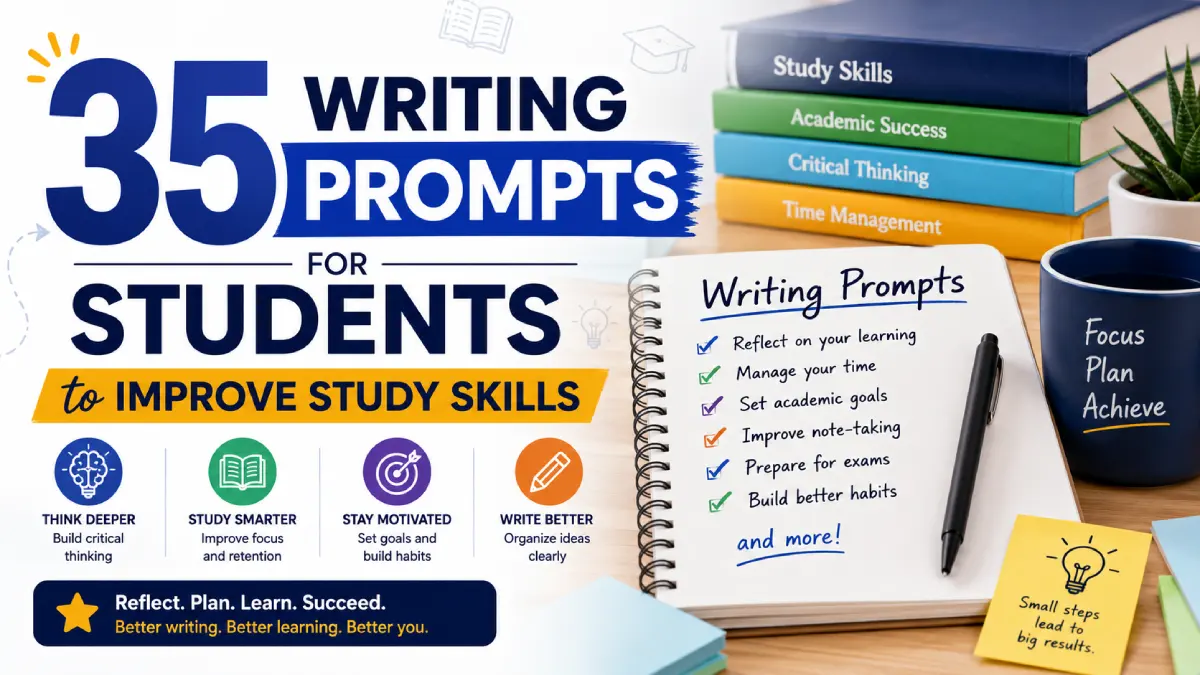
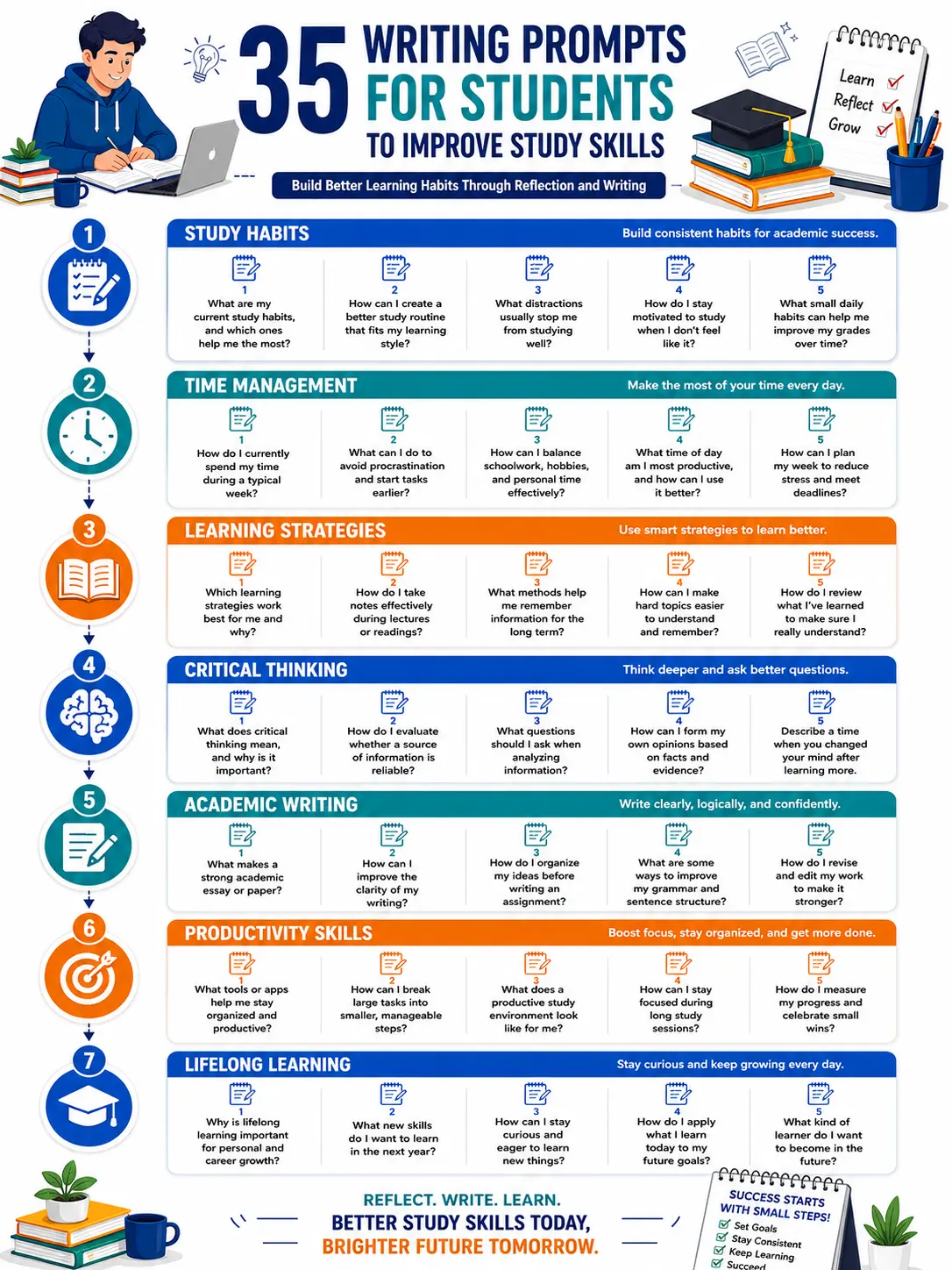
In this guide, you'll find 35 customizable writing prompts for students that can be adapted to different subjects, learning levels, and educational goals.
35 Writing Prompts for Students
1. Analyze Your Current Study Routine
Example AI Prompt:
Act as an academic coach and learning strategist. Analyze my current study routine in detail. I am a [grade/year/student type] studying [subject/course]. I typically study for [X] hours per day in [location]. I use [tools/apps/resources] and follow [study methods]. Identify at least 3 strengths and 3 weaknesses in my routine. Suggest practical improvements for productivity, focus, retention, and exam performance. Provide a step-by-step action plan I can implement immediately.
2. Design Your Ideal Study Environment
Example AI Prompt:
Act as a productivity expert and educational consultant. Help me design the ideal study environment based on my learning style. I am a [student type] who studies [subjects]. Consider factors such as lighting, noise levels, seating, technology, room organization, and study resources. Explain why each recommendation improves concentration and learning. Include separate recommendations for home study, library study, online learning, and group study sessions.
3. Reflect on a Successful Learning Experience
Example AI Prompt:
Act as a reflective learning coach. Help me analyze a successful learning experience where I mastered [subject/topic/skill]. Explain what study methods contributed to success, what challenges were overcome, and why the information was retained long-term. Identify lessons that can be applied to future learning situations. Create a framework that I can use to repeat similar academic success in other subjects.
4. Create a Weekly Study Improvement Plan
Example AI Prompt:
Act as a study planner and academic mentor. Create a detailed 7-day study improvement plan for me. My current academic goals are [goal]. I am studying [subjects] and can dedicate [hours] daily. Include daily objectives, focused study sessions, review periods, practice exercises, break schedules, and progress tracking methods. Make the plan realistic, balanced, and optimized for academic improvement.
5. Evaluate Your Time Management Skills
Example AI Prompt:
Act as a time management expert for students. Evaluate my current schedule and academic responsibilities. I spend approximately [hours] on classes, assignments, revision, extracurricular activities, and personal time. Identify time-wasting habits and productivity bottlenecks. Recommend practical strategies to improve scheduling, reduce distractions, and increase efficiency. Provide a revised weekly timetable and explain how it supports academic success.
6. Explain a Difficult Concept in Your Own Words
Example AI Prompt:
Act as an expert teacher who specializes in simplifying complex concepts. Explain [topic/concept] as if teaching it to a [middle school/high school/beginner] student. Use simple language, real-world examples, step-by-step explanations, and relatable analogies. Include common misconceptions, key takeaways, and a short summary. Make the explanation engaging and easy to remember.
7. Compare Two Study Techniques
Example AI Prompt:
Act as an educational psychologist. Compare [Study Method A] and [Study Method B] for learning [subject/topic]. Analyze their strengths, weaknesses, effectiveness for memory retention, exam preparation, understanding complex concepts, and long-term learning. Recommend which method would be best for different learning styles and academic goals. Include practical examples and situations where each technique works best.
8. Write About Your Biggest Academic Challenge
Example AI Prompt:
Act as an academic success coach. Help me analyze my biggest academic challenge, which is [describe challenge]. Explain possible causes, how it impacts learning and performance, and strategies to overcome it. Provide practical solutions, study techniques, productivity habits, and mindset changes that can help improve results. Create a personalized action plan for overcoming this challenge within the next 30 days.
9. Develop a Personalized Goal-Setting Strategy
Example AI Prompt:
Act as a goal-setting and academic planning expert. Help me create a personalized academic goal-setting strategy. My short-term goal is [goal], and my long-term goal is [goal]. Break each goal into actionable milestones, deadlines, and measurable outcomes. Identify potential obstacles and provide solutions. Include weekly progress checkpoints and motivational strategies to stay consistent throughout the learning journey.
10. Reflect on Your Note-Taking Habits
Example AI Prompt:
Act as a learning and note-taking specialist. Evaluate my current note-taking habits. I use [method/tool] during lectures, classes, or self-study sessions. Analyze the effectiveness of my approach for comprehension, memory retention, and exam preparation. Suggest improvements, alternative note-taking systems, digital tools, and organization methods. Provide examples of how an ideal note-taking process would look for my preferred learning style and academic subjects.
11. Explore the Impact of Technology on Learning
Example AI Prompt:
Act as an educational technology expert and learning strategist. Analyze how technology affects my educational experience. I regularly use [apps, websites, AI tools, online courses, educational platforms] for studying [subjects]. Discuss both the positive effects, such as accessibility, productivity, personalization, and collaboration, and the negative effects, such as distractions, information overload, and screen fatigue. Evaluate how technology supports or hinders my learning goals and provide recommendations for using digital tools more effectively while minimizing distractions.
12. Describe Your Exam Preparation Process
Example AI Prompt:
Act as an exam preparation coach. Help me analyze and improve my current exam preparation process for [subject/exam]. Explain how I should plan my study schedule, prioritize topics, revise effectively, practice questions, and track progress. Include stress management techniques, healthy study habits, and exam-day preparation strategies. Customize the advice based on my available study time, exam format, strengths, and weak areas. Provide a detailed step-by-step preparation framework.
13. Analyze a Learning Mistake
Example AI Prompt:
Act as a learning and self-improvement coach. Help me reflect on a learning mistake I made while studying [subject/topic]. Analyze what caused the mistake, how it affected my performance, and what lessons can be learned from the experience. Explain how I can prevent similar mistakes in the future through better study habits, planning, and decision-making. Create a personal improvement plan that turns this mistake into a valuable learning opportunity.
14. Create a Subject Mastery Roadmap
Example AI Prompt:
Act as a subject matter expert and academic mentor. Create a complete mastery roadmap for learning [subject]. My current skill level is [beginner/intermediate/advanced], and my goal is to achieve [specific objective]. Break the learning journey into milestones, weekly study plans, recommended resources, practical exercises, assessments, and progress checkpoints. Include estimated timelines and strategies for overcoming common learning obstacles. Make the roadmap realistic, measurable, and actionable.
15. Evaluate Your Reading Comprehension Skills
Example AI Prompt:
Act as a reading comprehension specialist. Evaluate my approach to reading academic materials such as textbooks, research papers, lecture notes, and study guides. Analyze how effectively I understand, retain, and apply information. Identify strengths and weaknesses in my reading process. Recommend strategies such as active reading, annotation, summarization, questioning techniques, and review methods. Create a personalized plan to improve my comprehension and long-term retention of academic content.
16. Reflect on Group Study Experiences
Example AI Prompt:
Act as a collaborative learning expert. Help me analyze my experiences with group study sessions. Discuss the benefits, challenges, communication dynamics, and learning outcomes of studying with others. Evaluate how group discussions, shared resources, peer teaching, and teamwork influenced my understanding of the subject. Recommend ways to make future group study sessions more productive and effective based on my learning goals and experiences.
17. Plan a Productive Study Week
Example AI Prompt:
Act as a student productivity coach. Create a detailed and realistic study plan for the next seven days. I am studying [subjects] and have [hours] available each day. Include study blocks, assignment deadlines, revision sessions, practice exercises, breaks, exercise, sleep, and wellness activities. Prioritize important tasks and explain how the schedule supports both academic success and personal well-being. Include methods for tracking progress and adjusting the plan if unexpected tasks arise.
18. Identify Your Learning Style
Example AI Prompt:
Act as an educational psychologist. Help me identify my primary learning style based on my study habits, academic experiences, and preferences. Analyze whether I learn best through visual materials, listening, reading and writing, hands-on activities, or a combination of approaches. Provide examples of effective study techniques for my learning style and explain how understanding my preferences can improve comprehension, retention, and academic performance.
Frequently Asked Questions
What are writing prompts for students?
Writing prompts for students are guided questions or scenarios designed to encourage reflection, creativity, critical thinking, and academic skill development through structured writing exercises.
How do writing prompts improve study skills?
Writing prompts encourage active engagement with learning materials, helping students improve memory retention, organization, comprehension, and self-assessment abilities.
How often should students use writing prompts?
Students can benefit from using writing prompts several times per week. Consistent practice supports long-term improvement in study habits and academic performance.
Using These Without It Becoming Busywork
Writing about studying can quietly replace studying. Two or three of these per term, written properly, beat working through the whole list in a week.
Pick the prompts that touch a habit you already suspect is weak. The rest will still be there next term.
For prompts aimed at publishing rather than studying, the creative set is the closer fit, and the research library covers structure and outlines.

Sabir
Founder of AIToolsay and a passionate AI enthusiast dedicated to building practical, user-friendly AI tools that simplify everyday tasks.
Discussion 0
Join the conversation — share your thoughts, ask questions, help others.
Be respectful. Comments are moderated.
No comments yet
Be the first to share your thoughts on this article.
Want more AIToolsay stories in your Google Search results?